The Verifiable Money Layer in iGaming : Solving Online Gambling's $116 Billion Trust Problem in 2026
The History of iGaming Evolution, Financial Systems, and the Next Generation of Crypto Casino Infrastructure
Anurag Sinha Roy

Back to all posts

Key Takeaways:
iGaming evolved through layers: regulation, infrastructure, scale, payments, and distribution.
Each layer solved growth problems, but none exposed how money actually moves.
Today, casino systems still rely on internal, operator-controlled financial ledgers.
This creates a core limitation: payouts, bankrolls, and liquidity cannot be independently verified in real time.
As the industry scales past $100B+ annually, this limitation becomes structural, not operational.
The next evolution of iGaming is not faster payments or better UX.
It is verifiability at the financial layer.
Systems that cannot prove solvency and fund flows will face increasing pressure from players, affiliates, and regulators.
Infrastructure that makes financial activity observable and auditable defines the next generation.
The History
The iGaming industry evolved due to the need to shift gambling online. Players wanted it, and with the development of tech to support that, it was a natural shift.
The first online casinos appeared in the mid-1990s. They were aided by jurisdictions like Antigua and Barbuda, which introduced new licensing frameworks. These allowed operators to legally offer gambling over the internet. From there, the industry expanded as technology improved, and software providers entered the market. That kept expanding as access to the internet became more widespread.
As time went on, online gambling became a global juggernaut with multiple layers. Regulation established legitimacy. Platform providers made it possible to launch and scale quickly. Global licensing models opened new markets. Payment systems reduced friction between deposits and gameplay. Distribution and media brought users in at scale.
But decades of innovation have not touched one fundamental issue.
The Underlying Problem
And no, it's not the product. The games work. The platforms are stable. The payments, in most markets, are faster than they were before. The devil is in the details. It is the financial layer. The part of this vast system that moves money between players, operators, and bankrolls. That layer has never been visible. To anyone.
Not to players. Not to affiliates. Not to regulators who must take operators at their word. Not even to investors who fund businesses built entirely on financial flows they cannot independently verify.
The iGaming industry operated on top of this opaque layer. Nobody has rebuilt it. Nobody has made it transparent.
And until now, nobody had the infrastructure to try.
How the Industry Was Built
But it is one thing to say the industry has a problem; it's another to find the source. And that can’t be understood without looking at the evolution of the iGaming industry.
2001–2011: The Rise of Online Gambling Regulation
Regulation solved one specific problem. It created accountability at the operator level.
The Malta Gaming Authority was established in 2001. In 2004, Malta became the first EU member state to pass comprehensive remote gambling legislation. The Remote Gaming Regulations created the first credible legal framework for online casino operators.
It was one that unlocked banking relationships, payment processors, and player confidence across European markets. An MGA-licensed operator had passed scrutiny. They had capital requirements. They had a regulator to answer to.
What regulation did not create was visibility into how money moved once a player deposited. Nor was there any clarity regarding the accuracy of their affiliate reports, or whether player funds were genuinely separated from operating capital.
The licence confirmed that the operator existed and was audited, but nothing about the real-time state of their bankroll.
2009–2016: How White-Label Online Casinos Changed iGaming
The change came with SoftSwiss. They began developing their casino platform in September 2012. By 2013, they had introduced cryptocurrency payments to traditional casino infrastructure, widely credited as the first company to do so. Their Game Aggregator, launched in October 2015, gave operators access to thousands of games through a single API connection.
The white-label model SoftSwiss pioneered transformed the industry's structure. Launch timelines dropped from twelve months to four to twelve weeks. Setup costs fell from millions of euros to a range of €10,000 to €150,000. Thousands of casino brands entered the market on shared infrastructure.
The infrastructure layer solved access. But it did not address the financial model underneath.
Under the white-label structure, the vendor provided the platform and collected fees and revenue share. The operator funded their own bankroll, often a million dollars or more locked as a capital reserve. They also absorbed 100% of the financial variance. A week of abnormal player wins sat entirely on the operator's balance sheet. The vendor's position was unchanged.
2007–Present: How Fast Licensing Changed Online Gambling
Operators who needed faster market entry found it through Curaçao licensing. Curaçao processed applications in weeks rather than months. This allowed operators to launch in markets that MGA-regulated operators had not yet reached. Under the legacy master license system, operators could be up and running with minimal oversight.
That system has now been fully dismantled under the LOK framework, the National Ordinance for Games of Chance. This came into full effect in late 2024, replacing sub-licensing with direct applications to the Curaçao Gaming Authority and mandatory AML compliance.
The distribution layer solved the speed of global expansion. The underlying financial opacity remained entirely intact.
2015–Present: The Rise of Frictionless Payments in Online Casinos
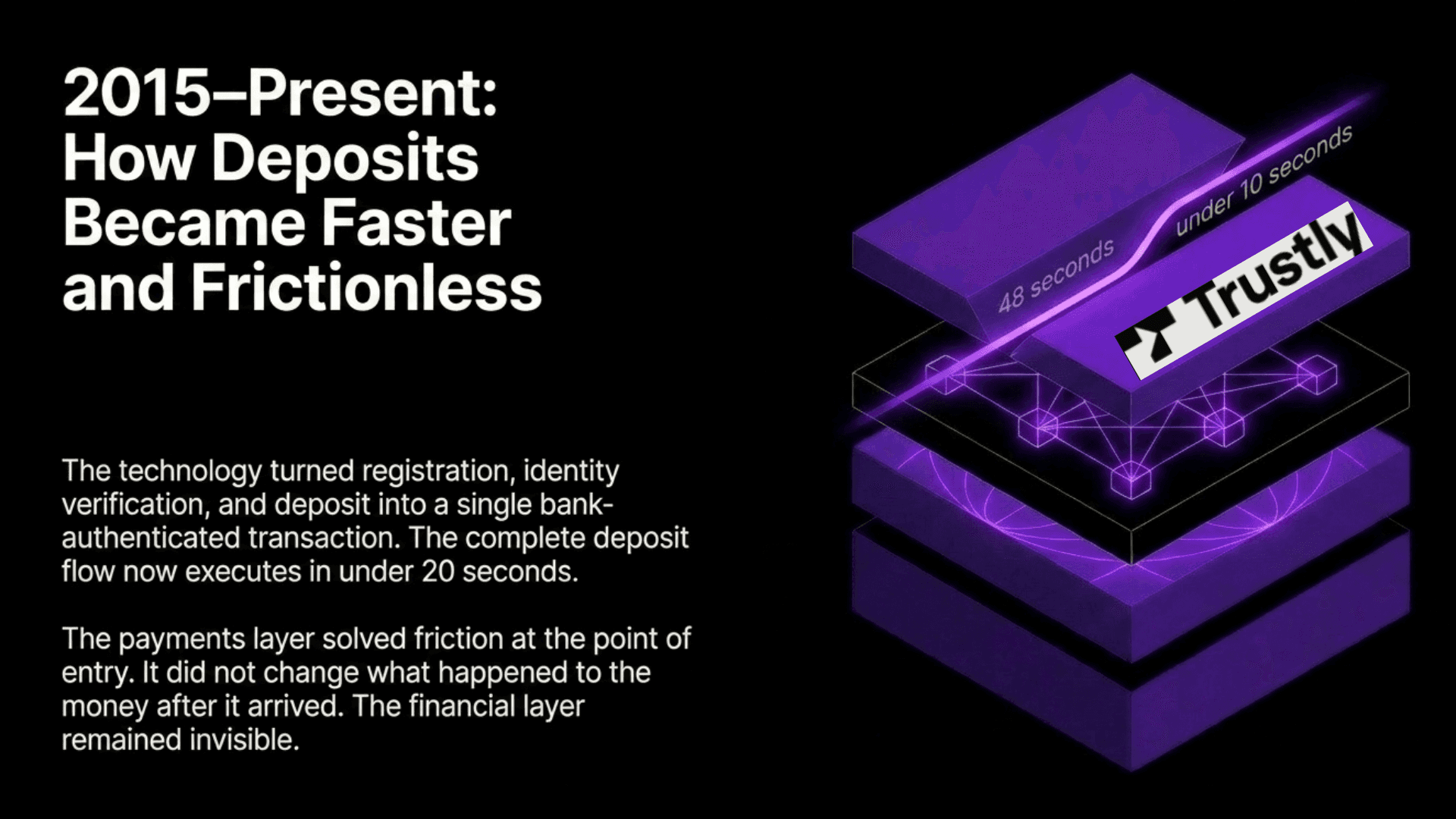
This much-needed change came after Trustly launched Pay N Play in 2015. The technology turned registration, identity verification, and deposit into a single bank-authenticated transaction. Its first commercial deployment was Ninja Casino in 2016. The model now operates across 250+ casino brands, 30 European markets, and over 3,300 banks.
At ICE 2025 in Barcelona, Trustly announced the next iteration, powered by its Azura data engine and biometric identification via Trustly ID. Login time dropped from 48 seconds to under 10 seconds. The complete deposit flow now executes in under 20 seconds.
The payments layer solved friction at the point of entry. It made depositing faster, simpler, and more secure. It did not change what happened to the money after it arrived. The financial layer remained invisible.
2017–Present: How Streaming and Media Changed iGaming Distribution
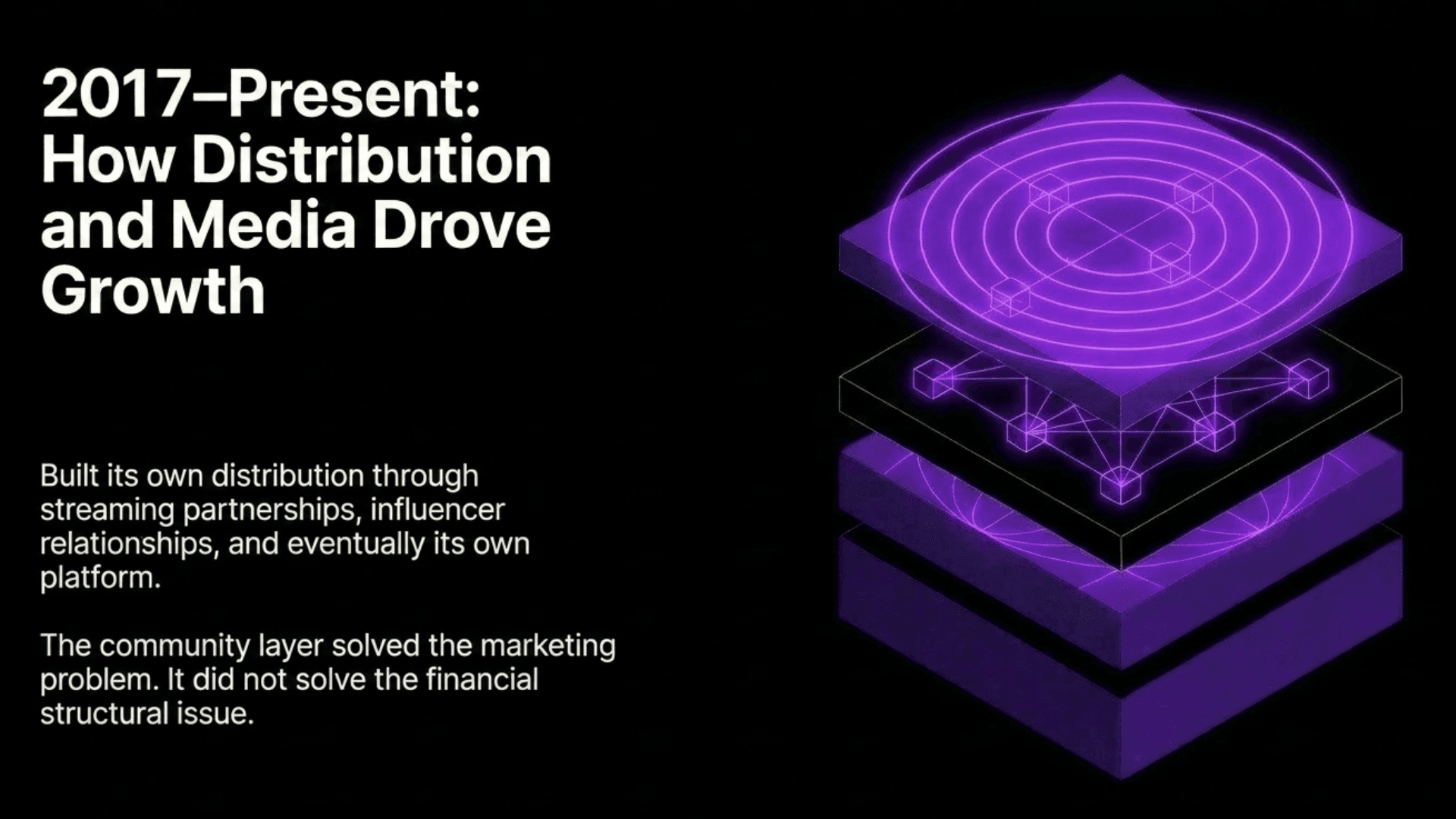
Stake.com, founded in 2017, built a different kind of competitive advantage. Rather than compete on product or price, it built its own distribution through streaming partnerships, influencer relationships, and eventually its own platform, Kick, launched in December 2022. By 2024, Stake reported $4.7 billion in gross gaming revenue. Its founders' combined estimated net worth reached $5.6 billion.
The community layer solved the marketing problem. It did not solve the financial structural issue.
Stake's financial infrastructure operated on the same trust-based model as every operator before it. Players deposited. Stake held the funds. Players had no mechanism to verify that the bankroll was real, that fund separation existed, or that cashback calculations were accurate.
The Structural Gap
Five generations of genuine iGaming innovation. But one problem remains untouched across all of them.
And this is the iGaming industry's biggest problem. It is not game fairness. It is not RNG or whether the product is good. The online gambling industry's unresolved issue is that the financial layer has never been verifiable.
There is a reason why players are increasingly becoming disillusioned with legacy gaming platforms. Consider what a player faces when they deposit into any casino operating under the current model.
Players cannot know:
If their funds are separated from the operator's operating capital.
If the bankroll holds sufficient liquidity to cover a large win.
Whether a delayed withdrawal is a processing issue or a liquidity problem.
If their cashback was calculated correctly, or at all.
The affiliates are on the same boat:
They cannot independently verify the player performance data in their dashboard.
They receive a report. They accept it or dispute it with no data of their own.
Regulators face the same issues:
Fund movements inside a licensed operator's system are internal.
Regulators audit retrospectively.
They do not observe live.
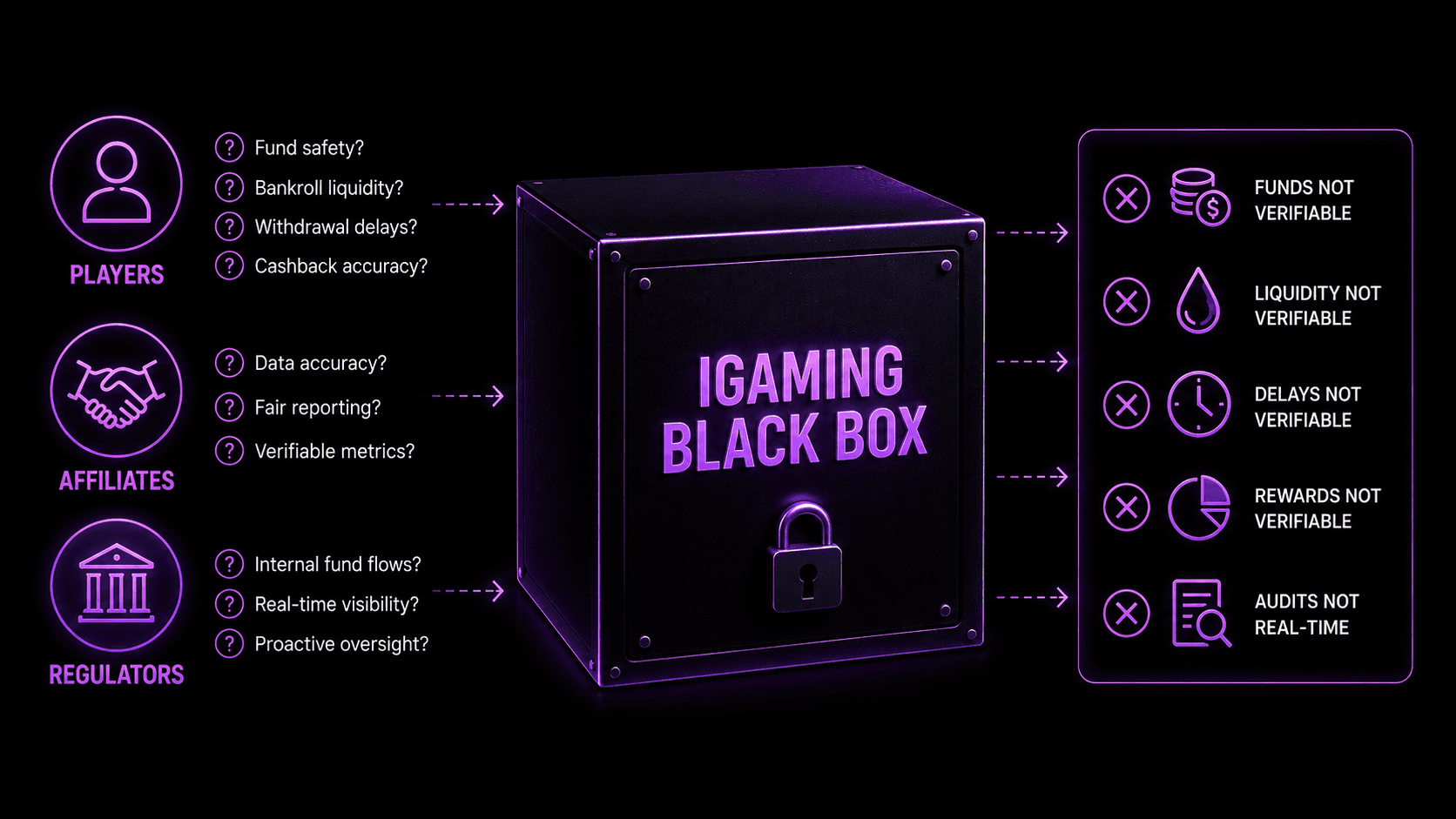
This is the iGaming black box. It has existed since the first online casino launched. It has survived every generation of innovation.
Why? Because nobody bothered to build at the layer where the problem resides, the financial infrastructure itself.
The scale of the problem reflects its persistence. The global online gambling market reached $116.6 billion in 2026. Crypto gambling alone generated $81.4 billion in gross gaming revenue in 2024. This was a fivefold increase from 2022, according to data from YieldSec reported by the Financial Times. Every dollar of that revenue flows through financial infrastructure that no external party can observe in real time.
So with that said, what is the solution, if indeed there is one?
What a Verifiable Financial Layer Looks Like
The answer is an industry-disrupting resounding “Yes” for iGaming platforms and crypto casinos. DeGaming is the first iGaming B2B infrastructure where every financial movement is recorded on-chain and independently verifiable in real time.
What is On-chain
Every financial event in the system is recorded on-chain in real time. When a player deposits into an online casino, the transaction is on-chain. When a player places a bet and loses, the movement of those funds from the player's account to the bankroll is on-chain. When a player wins, the movement from the bankroll to the player's wallet is on-chain.
The same goes for when cashback is calculated and distributed or when rakeback is paid. Every transfer between any party in the system is recorded, timestamped, and publicly observable.
This creates a complete, auditable financial history that no party controls and no party can alter. Players on online gambling platforms can verify that their funds have moved as described. Affiliates can verify performance data against on-chain records. iGaming operators can demonstrate solvency and fund separation without requiring anyone to take their word for it.
This is enabled by DeGaming’s Glass Vault, the architecture where every bet, payout, and balance is recorded on-chain and can be independently verified.
Game logic and operations in crypto casinos run on standard infrastructure. What changes is the financial layer. Every movement of funds is recorded on-chain and can be verified. Backend systems and databases are centralized.
Player account management, KYC processes, and operational tooling run on standard infrastructure. Payments involve both on-chain and off-chain elements, depending on the instrument and jurisdiction.
On Custody
Player wallets are custodial. DeGaming holds custody of the private keys and executes transactions on behalf of players. Custodial architecture means players cannot withdraw directly from a smart contract without the platform's involvement.
But custody does not affect visibility. The financial flows are fully observable regardless of the custody model. A player's funds moving from their account to the bankroll is on-chain, whether or not the player controls their own keys. The transparency is in the record, not in the key management.
Custodial does not mean opaque. Non-custodial does not mean transparent. The visibility comes from where financial events are recorded, not from who holds the keys.
How DeGaming is Solving The Capital Problem
Solving transparency, the iGaming industry's fundamental issue is more nuanced, and DeGaming has a bolder vision for the entire industry.
Emil Ahmed, the co-founder of DeGaming, explains the vision,
“We separated the bankroll from the brand. We built an infrastructure layer that changes what it means to be an operator. You no longer need to lock up large amounts of capital to fund a bankroll. You can focus on what actually drives growth: acquiring players, building a community, and scaling the brand. The liquidity sits at the infrastructure level.
At DeGaming, every financial interaction is visible and verifiable. Player funds are transparently separated. Deposits, bets, wins, withdrawals, cashback, rakeback. Every movement follows a clear and observable flow. When a player loses, funds move to the bankroll. When a player wins, funds move back to the player.
Trust is no longer something you ask for. It is something people can see.
A few years from now, I want people to look back at the old model and ask, how did anyone play at an online casino without seeing exactly how everything worked?”
That is the iGaming standard DeGaming.io is building.
Under every model that preceded this one, an operator launching a casino needed to fund their own bankroll. A credible bankroll, one large enough to handle normal variance and cover significant wins, typically millions of dollars. That capital sat idle as a reserve. It was not available for marketing. Not available for player acquisition. Not available for the product investment that actually drives growth.
The structural consequence was direct. Operators with less capital were disadvantaged, not because their product was worse. They just didn’t have enough money left for growth after meeting bankroll requirements.
DeGaming provides gaming liquidity through an infrastructure layer. Operators access that liquidity in exchange for a share of their gross gaming revenue. They do not fund the bankroll. They do not absorb the variance. If player wins exceed the statistical mean on a given day or week, that variance sits with the liquidity pool, not with the operator.
The operator's capital is entirely available for growth. All of it. This changes the financial model at a structural level. It is not an optimisation of the existing operator model. It is a different model. The operator becomes a brand and distribution business. The infrastructure handles the financial risk.
Under the previous model, the vendor relationship was extractive in one direction. The vendor took a fee and revenue share. The operator took all the risk. Under this model, the infrastructure provider participates in the outcome. When the operator grows, the system benefits. The interests are aligned in a way that the vendor model structurally cannot achieve.
DeGaming removes the need for operator-funded bankrolls by shifting liquidity and variance to the infrastructure layer.

The Distribution Opportunity
The financial infrastructure addresses how the money moves. The distribution question addresses where the players come from in modern iGaming and crypto casinos.
Telegram reached one billion monthly active users in March 2025, confirmed by founder Pavel Durov. Five hundred million people use it daily as of October 2025. Over 100 million users have activated Telegram's built-in crypto wallet.
The TON blockchain, which powers Telegram's financial layer, now processes over 2.1 million transactions per day, with 52.6 million on-chain activated wallets as of April 2026. This represents one of the largest untapped user bases for crypto-native iGaming. The infrastructure to serve Telegram's audience at an iGaming scale did not exist in any meaningful form.
DeGaming's architecture, on-chain financial flows, custodial wallet management, and Telegram-native deployment capability are built to operate in this environment natively.
What This Changes for iGaming, and What It Does Not
DeGaming does not replace the online casino model. It changes the financial infrastructure underneath it. Games run as they always have. Players play as they always have. Operators build brands as they always have.
What DeGaming changes is verifiability at the money layer. For the first time, the entities who interact with a casino, players, affiliates, operators, and investors, can observe financial flows directly rather than accepting reported data.
This does not eliminate all trust requirements from the system. Game providers still ask players to trust their RNG. Operators still make decisions that affect player experience. Custodial wallet management still requires players to trust the platform with their keys.
What it eliminates is the black box financial opacity. The specific, persistent problem that has defined this industry since its beginning. The inability to verify that money is where it is supposed to be becomes a solved problem.
The iGaming industry spent twenty years building regulation, infrastructure, distribution, payments, and community. Each layer added genuine value. None of them addressed the financial layer directly.
The shift toward verifiable financial infrastructure is not a philosophical position. It is an engineering decision with specific, measurable consequences.
Players who can verify their funds stay longer, and affiliates who can audit their data trust the platform more. Similarly, operators who can demonstrate solvency attract more players. And investors who can observe financial flows in real time have a clearer picture of what they are funding.
The market is US $116.6 billion and growing. Crypto gambling alone generated $81.4 billion in gross gaming revenue in 2024. This was a fivefold increase from 2022, per YieldSec and the Financial Times. Stablecoins now represent the dominant payment method in crypto gambling, with USDT commanding approximately 60% of stablecoin market capitalisation and stablecoins processing $27.6 trillion in transfer volume in 2024, surpassing Visa and Mastercard combined.
The infrastructure that serves this market is overdue for a rebuild at the financial layer, so that trust and transparency become synonymous with the iGaming industry.
DeGaming defines the next standard of the iGaming industry.
Sources:
Malta Gaming Authority — https://www.mga.org.mt/
Malta Gaming Act (Cap. 583) — https://legislation.mt/eli/cap/583/eng
Gaming Authorisations Regulations (S.L. 583.05) — https://legislation.mt/eli/sl/583.05/eng
Gaming Licence Fees Regulations (S.L. 583.03) — https://legislation.mt/eli/sl/583.03/eng
FIAU Malta Procedures & Guidance — https://fiaumalta.org/procedures-guidance-2/
Curaçao Gaming Authority (CGA) — https://www.cga.cw/
Curaçao Gaming Control Board — https://www.gamingcontrolcuracao.org/
Curaçao LOK Transition Framework — https://www.gamingcontrolcuracao.org/lok-transition
Curaçao LOK Fee Structure — https://the-emgroup.com/lok-new-fee-structure/
Financial Action Task Force (FATF) — https://www.fatf-gafi.org/
Markets in Crypto-Assets Regulation (MiCA) — https://eur-lex.europa.eu/legal-content/EN/TXT/?uri=CELEX%3A32023R1114
Transfer of Funds Regulation (TFR / Travel Rule) — https://eur-lex.europa.eu/eli/reg/2023/1113/oj
ESMA Crypto-Assets Policy — https://www.esma.europa.eu/policy-activities/crypto-assets
Global Online Gambling Market Size, Share & Trends Analysis — https://www.grandviewresearch.com/industry-analysis/online-gambling-market
Global Online Gambling Market Forecast ($116.6B, FMI) — https://www.futuremarketinsights.com/reports/online-gambling-market
Financial Times (crypto gambling / YieldSec reference) — https://www.ft.com/content/2490279b-9c94-49a8-beff-cbd7c3307586
American Gaming Association — Illegal Gaming Market Report — https://www.americangaming.org/new-aga-analysis-reveals-illegal-gaming-remains-nearly-a-third-of-the-u-s-market/
Trustly Pay N Play — https://www.trustly.com/products/paynplay
Trustly Press / Data / ICE announcements — https://www.trustly.com/press
Telegram (official) — https://telegram.org/
Telegram statistics — https://www.statista.com/topics/1482/telegram/
TON official — https://ton.org/en
TON on-chain data (live) — https://www.tonstat.com/