The Future of Web3 iGaming - DeGaming's Glass Vault Transparency
Designing iGaming transparency that the industry needs with the speed players have been missing.
Anurag Sinha Roy

Back to all posts

DeGaming's Glass Vault Evolution in Web3 iGaming
Summary:
The Core Problem: Legacy "Black Box" systems centralize logic and balances, causing opacity, instability, and trust deficits.
The Shift: Migration from private, internal databases to transparent, verifiable Web3 frameworks.
Infrastructure: Augmenting RDBMS with an on-chain record of deposits, bets, wins, and payouts.
Player UX: Custodial wallets for seedless onboarding and no gas management for players.
Faster Payouts: Transitioning from multi-day banking cycles to automated flows for improved retention.
Verifiable Money: Every financial event written to the chain, from deposits and bets to cashback and free spins.
Evolving Compliance: Moving from static, one-time KYC to Continuous KYT (Know Your Transaction) monitoring.
The Mandate: Transparency and reliability are becoming commercial requirements rather than differentiators.
One of the most iconic songs of all time, “The Gambler” by Kenny Rogers, had the world singing:
“You’ve got to know when to hold ’em
Know when to fold ’em
Know when to walk away
And know when to run
You never count your money
When you’re sittin’ at the table"
That still rings true, whether it’s gambling in a crypto casino platform or sports betting. We have come a long way since physical casinos were the only gateway to trying our luck. The rise of crypto casinos and Web3 iGaming is changing the online gambling experience from the ground up. Blockchain-based infrastructure, crypto payments, faster withdrawals, and greater financial transparency are becoming central to how modern iGaming platforms compete for players and build trust.
In 2025, the online gambling industry was valued at US$88.0 billion. The market is estimated to reach US$97.7 billion in 2026 and is projected to become a massive US$202.8 billion global juggernaut by 2033, with a CAGR of 11.0% from 2026 to 2033 (Grand View Research, 2026).
Betting on sports became the most lucrative market, taking a massive 50% of all online gambling revenue in 2025. The USA remains the largest single country market, while Asia Pacific is now the fastest-growing region.
It’s not like Europe is far behind. Yes, traditionally, we have seen that the regulations are stricter when it comes to online gambling in the EU. However, with the rise of Anjouan and Curaçao gambling licenses, which have more relaxed rules, European operators are growing faster than ever. Europe held over 41% of the global online gambling market in 2025, the largest share of any region. Sports betting again was the most lucrative.

But the industry growth is hiding a critical weakness at its core. The underlying infrastructure is not only not prepared for this, but it is fundamentally broken. Operators still running their business on legacy systems are carrying costs that newer architectures avoid.
Because of the complexities or fear of migrating to newer Web3 environments, the operators are facing revenue loss, broken player trust, and an automation revolution disrupting established payment orders.
iGaming Players no longer care about these “Black Box” systems in online gambling or betting. Why would they? Nobody wants to trust blindly in the fact, anymore, that the operator will have an iron grip on both game logic and player liquidity.
The misconception is that these legacy operators still think they can just gain new players. However, most stats show that retaining player loyalty is five to seven times cheaper than getting new ones. So, what’s the solution?
For 2026 and beyond, the online gambling industry’s biggest power will be transparency. So the solution is DeGaming's "Glass Vault” architecture. What do we mean by “Glass Vault” in iGaming? Simply put, it destroys the Black Box and replaces it with an on-chain financial record anyone can verify. And no, this is not just a mere software upgrade. This is a complete overhaul of legacy iGaming vs crypto casino economics.
Web3 transparent iGaming platforms will replace Black Box opacity with cryptographic transparency.
Why Legacy iGaming Systems are Failing
If we are to understand the need for a Glass Vault architecture, we need to look at why the legacy Player Account Management (PAM) systems are failing. Most of them are built on relational databases (RDBMS) designed for reliable transactions. Unfortunately, they struggle under a heavy, real-time load. In an iGaming environment, this creates bottlenecks during peak moments.

Take, for example, major sporting events like a Premier League final match or the Super Bowl, etc. These systems must be able to handle simultaneous updates like changing odds, new bets, and changing player balances. But in reality, as activity increases, shared data (like user balances) becomes a point of contention, leading to delays and slower system performance. For users, this is lag, failed actions, or even full platform crashes. The impact is undeniable.
Industry benchmarks show Day-30 retention for iGaming platforms is typically 15–25% with top operators reaching 30–40% (Xtremepush, 2026). As if that wasn’t enough, 88% of users often leave an app after repeated glitches.
Ask yourself, would you trust a gambling platform where your funds are stuck at critical moments?
Issue | Impact |
High concurrency load | Slower system response |
Shared database contention | Transaction delays |
Real-time updates (odds, bets) | System instability |
Peak traffic events | Crashes/downtime |
Poor performance | User frustration |
Why iGaming Players Leave a Platform
Churn in iGaming refers to the players who stop engaging with a game or platform, often not returning at all. It is worthwhile to remember that only 2% of the players can generate more than 50% of an online betting platform's entire revenue. So, imagine if these players silently start leaving the platform because of issues related to accessing funds or otherwise.
A recent study suggests that rage clicks in iGaming and betting have gone up three times the industry average (FullStory). One of the major contributors to player frustration is withdrawal latency. But why are withdrawals slow in online casinos? Traditional platforms often rely on legacy banking rails designed for batch-processed transfers, not real-time digital experiences. The ACH and SWIFT systems being used are not aligned with the new generation of players and their expectations.
Standard domestic ACH transfers typically take 1 to 3 business days to settle (Wise). While Same Day ACH supports higher transaction limits of up to $1 million (Nacha), processing remains constrained by banking hours, including weekends and holidays. For international transfers, friction increases further. Cross-border payments routed through SWIFT often take several business days, depending on intermediary banks and settlement conditions.
This delay between winning and being able to access the money, or slow manual verification processes, leaves players frustrated. Coming down from the high of winning to having to wait for funds is a major reason why trust is failing with many legacy game providers. And then many operators will try to address this with loyalty programs and bonus systems. But that doesn’t fix the underlying infrastructure.
Metric | Insight |
Day-30 Retention | 15–25% |
Top Operators | 30–40% |
High-value players | 2% generate 50%+ revenue |
Rage clicks | 3x cross-industry average |
App abandonment | 88% after glitches |
How DeGaming's Glass Vault Architecture Works
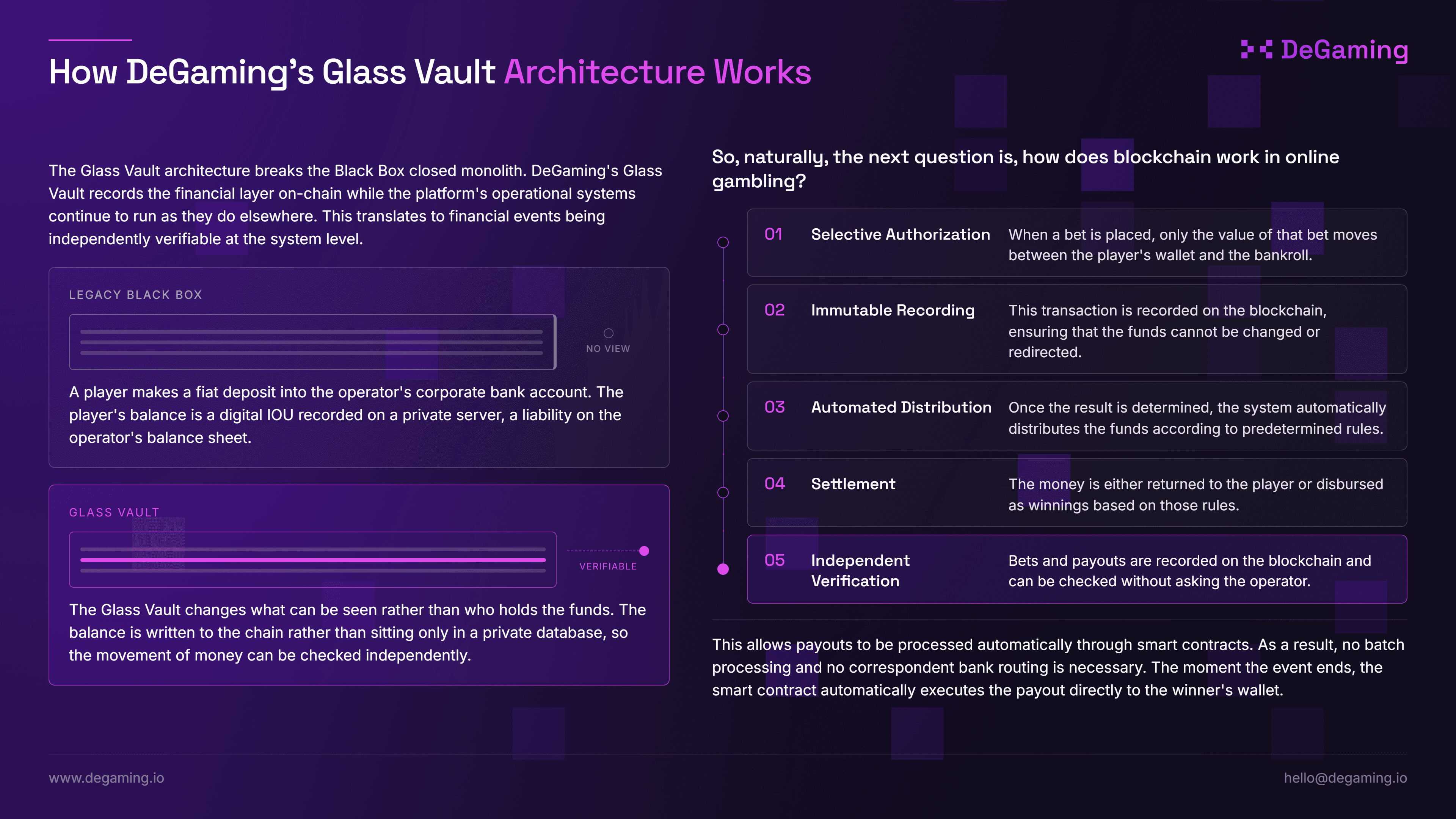
The Glass Vault architecture breaks the Black Box closed monolith. DeGaming's Glass Vault records the financial layer on-chain while the platform's operational systems continue to run as they do elsewhere. This translates to financial events being independently verifiable at the system level.
In a legacy Black Box, a player makes a fiat deposit into the operator's corporate bank account. The player’s balance is a digital IOU recorded on a private server, a liability on the operator's balance sheet.
The Glass Vault changes what can be seen rather than who holds the funds. The balance is written to the chain rather than sitting only in a private database, so the movement of money can be checked independently.
So, naturally, the next question is, how does blockchain work in online gambling?
Selective Authorization: When a bet is placed, only the value of that bet moves between the player's wallet and the bankroll.
Immutable Recording: This transaction is recorded on the blockchain, ensuring that the funds cannot be changed or redirected.
Automated Distribution: Once the result is determined, the system automatically distributes the funds according to predetermined rules.
Settlement: The money is either returned to the player or disbursed as winnings based on those rules.
Independent Verification: Bets and payouts are recorded on the blockchain and can be checked without asking the operator.
This allows payouts to be processed automatically through smart contracts. As a result, no batch processing and no correspondent bank routing is necessary. The moment the event ends, the smart contract automatically executes the payout directly to the winner's wallet.
High-value transactions can trigger escrow and manual release. Settlement occurs at the protocol layer, operating 24/7/365 without regard for things like banking holidays.
One-Click Gaming: How Custodial Wallets Fix Web3 Onboarding
But what has been the main barrier to Web3 adoption by legacy operators? It is the technical mismatch and lack of infrastructure required to interact with blockchain networks. High-stakes players don't want to deal with the hassle of 12-word recovery phrases or calculating 'gas fees' for every move. Neither do those who want to buy specific network tokens just to place a single bet. It takes the fun away from gambling.
The Glass Vault handles this at the infrastructure level. Player wallets on the platform are custodial, so DeGaming holds the keys and executes transactions on the player's behalf.
Simple Onboarding: Instead of writing down seed phrases, players can sign up and secure their accounts using standard methods.
Gasless Betting: The casino covers the network fees for the player.
Seamless Play: The result is a gasless environment that feels as smooth as a regular app, while still giving the player the security and on-chain record of the blockchain.
What the Blockchain Actually Records in a Crypto Casino
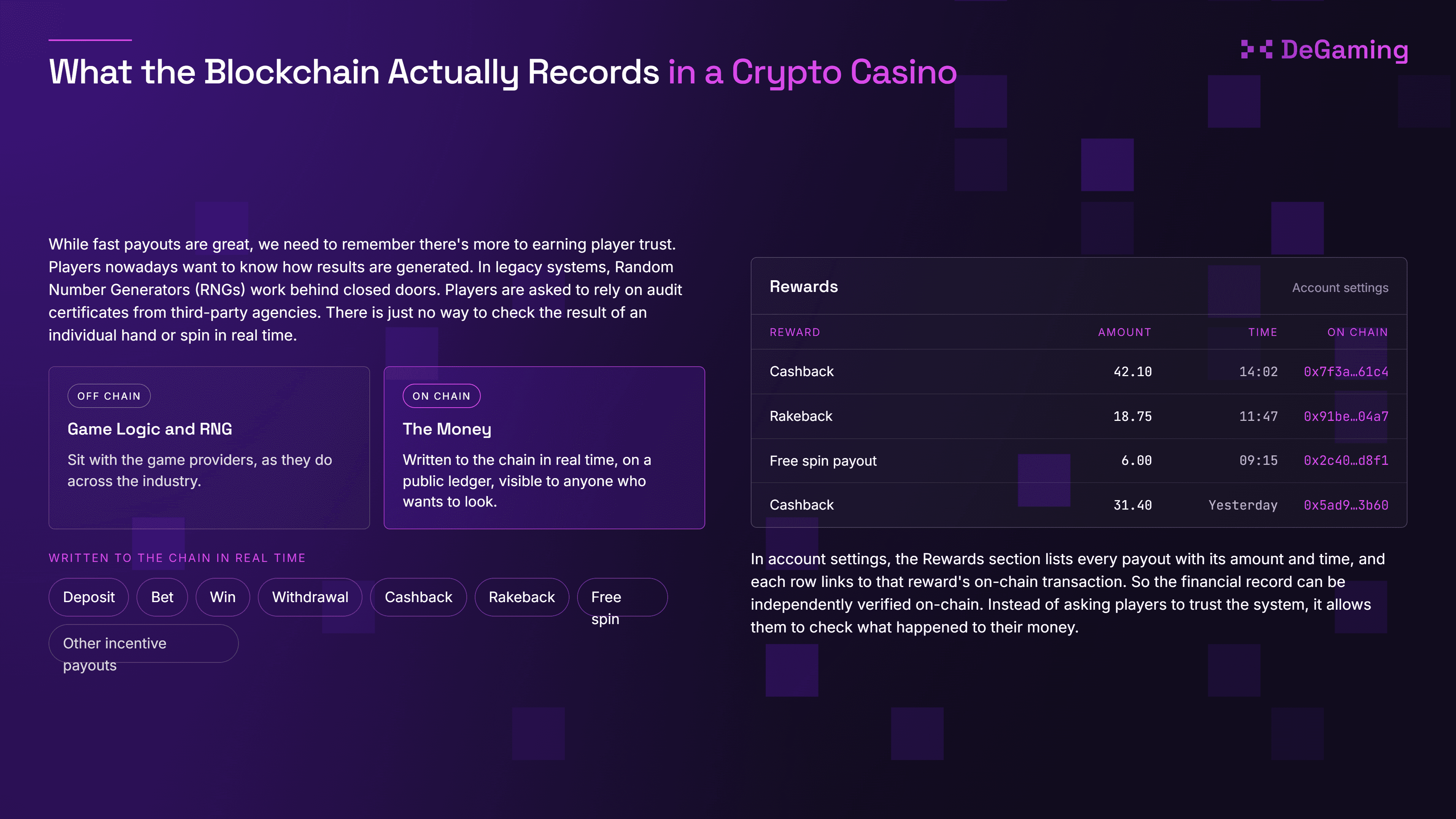
While fast payouts are great, we need to remember there's more to earning player trust. Players nowadays want to know how results are generated. In legacy systems, Random Number Generators (RNGs) work behind closed doors. Players are asked to rely on audit certificates from third-party agencies. There is just no way to check the result of an individual hand or spin in real time.
Game logic and RNG sit with the game providers, as they do across the industry. What the Glass Vault makes verifiable is the money. Every deposit, bet, win, withdrawal, cashback, rakeback, free spin, and other incentive payout is written to the chain in real time, on a public ledger, visible to anyone who wants to look.
In account settings, the Rewards section lists every payout with its amount and time, and each row links to that reward's on-chain transaction. So the financial record can be independently verified on-chain. Instead of asking players to trust the system, it allows them to check what happened to their money.
Compliance as Infrastructure: KYC and KYT in Web3 iGaming
The shift towards the Web3 Glass Vault transparency is not solely driven by technological superiority. There is global regulatory pressure as well. In 2025, global AML/CFT penalties across key growth sectors reached $1.1 billion. This massive enforcement action was part of a broader crackdown, with global regulatory fines surging 417% in the first half of 2025 alone (Fenergo, 2025).
The distribution of these fines highlights a massive compliance gap. The cryptocurrency sector absorbed $927.5 million of these penalties, while traditional casinos accounted for $32.3 million (FinIntegrity, 2025). One of the largest was the US $504 million levied against OKX in February 2025, following a guilty plea over anti-money laundering failures.
The European Union's Anti-Money Laundering Authority (AMLA) launched its powers and responsibilities on 1 July 2025, but direct supervision of selected high-risk financial institutions is scheduled to begin in 2028.
Added to that, MiCA requires crypto-asset services to be provided by entities that have been authorised as crypto-asset service providers (CASPs). Crypto-asset service providers must at all times meet the conditions for their authorisation. They are also subject to prudential safeguards, including permanent minimum capital requirements and requirements relating to fixed overheads.
This requires a fundamental shift in how operators view risk. Legacy systems often rely heavily on Know Your Customer (KYC) procedures conducted at onboarding. In Web3 iGaming, ongoing transaction monitoring can provide an additional layer of risk oversight. Dynamic KYT vs static KYC crypto iGaming represents the next evolution of compliance.
Because blockchain ledgers are transparent, transaction-monitoring systems can trace the movement of funds across wallet addresses and identify activity associated with sanctioned entities, known exploit addresses, or other high-risk sources.
This level of compliance extends beyond anti-money laundering. Under the UK Gambling Commission's Licensing Conditions and Codes of Practice (Condition 7.1.1), operators must ensure that the terms on which gambling is offered are fair and transparent, and that those terms are made available to customers in an easily accessible way.
DeGaming's integration with Shufti Pro is built on the same principle. Identity verification and AML screening are native to the platform rather than bolted on, covering 240+ countries and territories, with real-time identity checks and continuous AML screening running alongside the on-chain financial record.
What the Future of iGaming Infrastructure Looks Like
It’s simple. Operators that choose the transparency of Web3 iGaming platform providers will survive and thrive. Black Box systems, where a private database controls both the game and the player’s balance, will keep losing trust and fade away. Transparency will become the online gambling industry’s core advantage.
Comparison: Legacy vs Web3 iGaming
Feature | Legacy Monolith (The Black Box) | The Glass Vault (Web3 Architecture) |
|---|---|---|
Data Storage | Private, centralized RDBMS (SQL) | RDBMS retained, with financial events recorded on-chain |
Financial Record | Private internal ledger | Financial events written on-chain |
Trust Model | Trust-based (certificates, audits) | Verification-based where applicable |
Asset Control | Custodial, with no visibility into holdings | Custodial, with balances and movements recorded on-chain |
Compliance | Static KYC (one-time checks) | Continuous monitoring approaches (KYT, transaction tracking) |
Performance | Can degrade under peak load | Can scale through distributed and modular systems |
Withdrawals | Manual processes; delays are common | Automated flows are possible, depending on system design |
FAQ
What is DeGaming's Glass Vault in iGaming?
DeGaming's Glass Vault is an architecture where financial activity like deposits, wagers, wins, and payouts is recorded on-chain and can be verified instead of relying entirely on internal systems.
What is a major contributor to player churn in legacy iGaming platforms?
Withdrawal latency. Traditional platforms rely on ACH or SWIFT networks, taking 1 to 3 business days to settle. This delay breaks the post-win dopamine loop, eroding player trust and driving rage clicks.
How does the Glass Vault architecture handle player funds?
Wallets are custodial. What changes is visibility. Deposits, bets, wins, and withdrawals are written to the chain, so a player can check the movement of their money rather than take a balance on trust.
What solves the friction of Web3 onboarding for traditional players?
Custodial wallets. Players sign up using standard methods and never handle a seed phrase or a gas fee, because the platform executes transactions on their behalf.
What can players actually verify on-chain?
The money. Game outcomes are produced by the game providers, as across the industry. What the Glass Vault records on-chain is every deposit, bet, win, withdrawal and incentive payout, each of them checkable.
What is the difference between KYC and KYT in the new regulatory landscape?
KYC is a one-time identity check. KYT monitors the flow of funds on an ongoing basis. On the DeGaming platform, identity verification and continuous AML screening run natively through the Shufti Pro integration.
If the blockchain is a public ledger, how do high-value players maintain their privacy?
The Glass Vault is transparent without making a player's personal identity public. Transactions are recorded on-chain and are visible through wallet addresses, while personal identity and KYC information remain separate from the public on-chain record. DeGaming's model uses custodial wallets, so players can verify funds and transactions without exposing their personal identity on the public ledger.
Does moving to Web3 mean operators can bypass gambling licenses?
No. Moving an iGaming operation to Web3 does not remove its gambling licensing or regulatory obligations. Gambling remains subject to the laws and licensing requirements of the relevant jurisdiction.
References:
Gamification Benchmarks 2026: What's a Good Retention Rate, Engagement Score, and Tier Progression? – https://www.xtremepush.com/blog/gamification-benchmarks-2026-whats-a-good-retention-rate-engagement-score-and-tier-progression
Online Gambling Market Size And Share Report, 2026-2033 – https://www.grandviewresearch.com/industry-analysis/online-gambling-market
Global Online Gambling Market Size & Outlook – https://www.grandviewresearch.com/horizon/outlook/online-gambling-market-size/global
Survey: 88% of App Users Will Abandon Apps Based on Bugs and Glitches – https://www.quality-ai.com/insights/news/survey-88-of-app-users-will-abandon-apps-based-on-bugs-and-glitches
ASK MAT – Is the U.S. Financial Crime Enforcement Loosening the Reins or Tightening the Noose? – http://www.comsuregroup.com/news/ask-mat-is-the-us-financial-crime-enforcement-loosening-the-reins-or-tightening-the-noose/
AML and KYC Regulations in Crypto – https://www.nadcab.com/blog/aml-and-kyc-regulations-in-crypto
Licence Conditions and Codes of Practice (LCCP) – https://www.gamblingcommission.gov.uk/licensees-and-businesses/lccp
7.1.1 - Fair and transparent terms and practices – https://www.gamblingcommission.gov.uk/licensees-and-businesses/lccp/condition/7-1-1-fair-and-transparent-terms-and-practices
UKGC Significant LCCP changes – https://gamingassociates.com/blog/ukgc-significant-lccp-changes/
MiCA: Requirements for CASPs – https://www.lw.com/en/markets-in-crypto-assets-regulation-tracker/mica-requirements-casps
AML, CFT, and Sanctions Enforcement Actions in 2025 – https://finintegrity.org/aml-cft-and-sanctions-enforcement-actions-in-2025/
The Biggest AML Fines in 2025 – https://complyadvantage.com/insights/the-biggest-aml-fines-in-2025/
OKX Pleads Guilty To Violating U.S. Anti-Money Laundering Laws And Agrees To Pay Penalties Totaling More Than $500 Million – https://www.justice.gov/usao-sdny/pr/okx-pleads-guilty-violating-us-anti-money-laundering-laws-and-agrees-pay-penalties
How long does an ACH transfer take? – https://wise.com/us/blog/how-long-does-ach-take
Same Day ACH $1 Million Per Transaction Limit Guidance – https://www.nacha.org/news/same-day-ach-1-million-limit-guidance
SWIFT Money Transfer: Process, Fees and Timeline – https://www.skydo.com/blog/swift-money-transfer-ultimate-guide
Cost of Customer Acquisition vs. Retention: Stats & Strategy – https://www.yotpo.com/blog/cost-of-customer-acquisition-vs-retention/