Anjouan vs Curaçao: The Web3 iGaming License Guide
How Web3 iGaming startups should structure licensing to avoid early capital burn and scale efficiently.
Anurag Sinha Roy

Back to all posts
Anjouan vs Curaçao iGaming License: Which One Should You Choose?
The choice between Anjouan vs Curaçao iGaming license depends on the stage the iGaming brand is at. Both licenses support gambling, sportsbook, and crypto casino platforms. But they are designed for different phases of an operator’s lifecycle.
Summary:
Failure & Compliance Costs: Web3 cryptocurrency enterprises face a 95% failure rate, driven heavily by disproportionate financial crime compliance costs that surged to $85 billion in the EMEA region alone.
The Agile Entry Point: The Anjouan gaming license provides an operational launchpad with 0% Gross Gaming Revenue (GGR) tax and a flat €17,828 annual renewal fee, requiring zero minimum share capital.
Anjouan Risks: Operators utilizing Anjouan must navigate regulatory uncertainty, as multiple entities claim sub-licensing authority under the Computer Gaming Act of 2005.
Curaçao LOK Framework: The Curaçao Gaming Authority (CGA) modernized its framework through the National Ordinance for Games of Chance (LOK), which abolished the legacy master license system.
Curaçao Cost: Direct B2C licensing under the Curaçao LOK regime imposes strict financial mandates, totaling €47,450 in annual national treasury and supervisory fees. Curaçao B2B licensing costs €24,490 per year.
The most effective approach is sequential. Operators start with Anjouan to validate product-market fit and preserve capital, then transition to Curaçao as compliance requirements, payment access, and operational scale increase.
Feature | Anjouan Gaming License | Curaçao Gaming License (LOK) |
Primary Intent | Rapid PMF, smart contract testing | Brand standardization, B2B access |
Base Annual Cost | €17,828 | €47,450 (B2C) / €24,490 (B2B) |
Corporate Tax Rate | 0% (IBC) | 2% (E-Zone) |
Minimum Share Capital | €0 | €0 (operational funds required) |
Physical Office Mandate | Not required | Required |
Banking Access | Crypto-native | Fiat + EMIs |
Regulatory Directives | 2005 Computer Gaming Act | National Ordinance for Games of Chance (LOK) |
How Web3 iGaming Licensing Costs Kill New Startups
The global online gambling market achieved an estimated valuation of US$ 116.6 billion in early 2026. Some market projections forecast an aggressive expansion to $286.4 billion by 2035. The growth market looks strong. The reality is that new iGaming companies are struggling. Unfortunately, the data reveals an ugly truth.
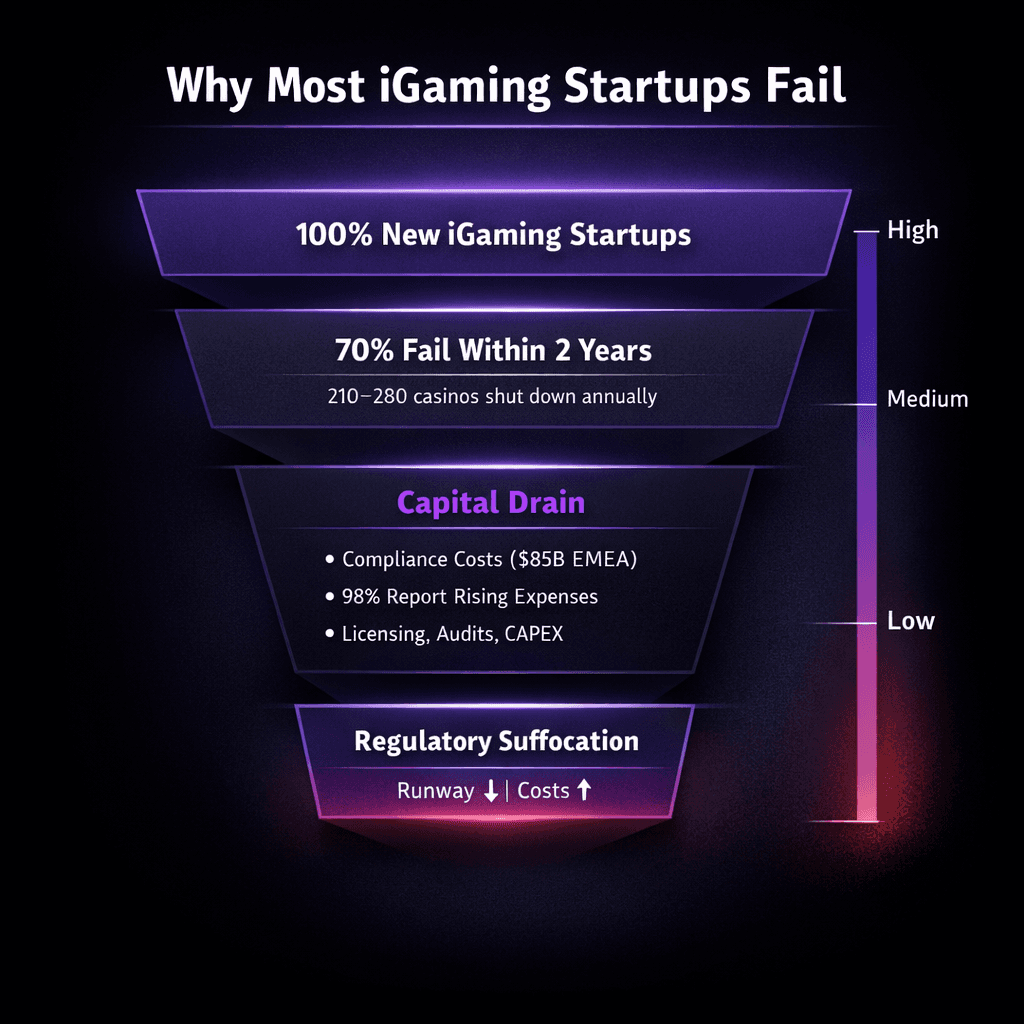
Around 70% of new online casinos fail within their first two years. Each year, roughly 210 to 280 online casinos shut down globally. These failures usually happen because of: money problems, licensing or legal issues, weak Web2 technology, or poor user experience, and inability to have transparent iGaming operations. The failure rate for blockchain and cryptocurrency-focused enterprises increases to a staggering 95%.
Besides outdated Web2 technology, the other reason why businesses fail is running out of money for the wrong reasons. Across the financial and payments sector, compliance costs have surged. In the EMEA region, financial crime compliance costs reached $85 billion. 98% of financial institutions report rising compliance expenses, forcing them to cut costs across their programs.
For nascent Web3 projects, trying to handle the compliance burden of a Tier-1 institutional jurisdiction from Day One is unrealistic. Building experimental smart contracts and decentralized liquidity systems requires a strong developer focus. Not to mention a lot of capital. Founders often misjudge timing by trying to secure elite institutional licenses before reaching Product-Market Fit (PMF). PMF simply means that your product solves a real problem and people want to use it.
This strategic error triggers Regulatory Suffocation. The condition becomes a crippling operational bottleneck and starts depleting the funds. Why? Because it gives way to bureaucratic drag, continuous third-party audit mandates, and massive capital expenditures (CAPEX). Growth stalls completely.
On the other hand, legacy Web2 Player Account Management (PAM) operators have decades-old brands, large market share, and deeply established banking relationships. For them, maximizing regulatory prestige is a logical strategy.
Web3-native companies operate under very different, decentralized market conditions:
Fast smart contract iteration
decentralized random number generation (RNG)
automated yield systems.
In this context, regulatory friction acts as a direct cost on innovation during the early stages.
The Compliance Ladder for Decentralized iGaming Operators
Modern Web3 operators have to find a new approach to compliance. Instead of following rigid, one-size-fits-all rules, they must optimize based on jurisdiction. Crypto casinos and blockchain-based sportsbooks face a constant trade-off between Operational Velocity and Institutional Legitimacy.
Operational Velocity is the ability to iterate quickly, deploy code, and acquire users.
Institutional Legitimacy is the regulatory trust needed to access Tier-1 banking rails like SEPA/SWIFT and global payment processors.
Starting at the top of the regulatory hierarchy slows everything down. High compliance costs, bureaucratic delays, and six-figure capital requirements drain liquidity. And all these even before the platform can generate meaningful revenue.
The Compliance Ladder solves this trade-off.
Instead of treating compliance as a fixed requirement, it becomes a phased strategy. Regulatory obligations scale with the business, based on revenue, active users, and overall financial risk.
This allows operators to start lean. At the early stage, the platform can:
validate its core mechanics
test tokenomics
operate with minimal overhead in offshore environments
Once the business achieves stable, predictable cash-and-carry revenue, it can move into more structured jurisdictions. At that stage, the focus shifts to:
strengthening internal audits
improving compliance systems
preparing for higher regulatory standards
By aligning compliance with the actual stage of the business, operators avoid unnecessary capital drain while maintaining the ability to scale.

Understanding the Anjouan Gaming License Framework
The Anjouan gaming license is an offshore iGaming license that allows operators to legally offer online gambling services under the Computer Gaming Act of 2005. It acts as a fast, flexible legal framework for launching online casinos, sportsbooks, poker, bingo, etc. The license is regulated by the Anjouan Offshore Financial Authority.
It is no secret that technical and market-based vulnerabilities threaten decentralized applications heavily, especially during the initial launch phase. Smart contract exploits, oracle manipulation, and tokenomics collapse present immediate risks.
For Web3 betting platforms, operational flexibility is one of their top priorities. The Anjouan licensing framework allows operators to launch and operate internationally under a defined but efficient regulatory structure. Developers deploy core technical infrastructure, including game integrations and Liquidity Provider (LP) bankrolls. This allows them to validate mathematical mechanics in a live environment.
There are significant benefits to operating under the Anjouan framework. It allows developers to operate with fewer upfront regulatory constraints compared to EU jurisdictions. Anjouan permits operators to host primary or mirrored servers globally. Regulatory requirements include maintaining compliance standards, including data protection, system integrity, and ongoing oversight. Cloud-native architectures can also support this flexible hosting model.
So, how does hosting work under the Anjouan license?
Operators are allowed to run their platforms using servers located anywhere in the world. This means you don’t need to host everything in one country or within the jurisdiction itself.
Does that mean there are no rules?
No. Even though you can operate globally, you still need to follow basic compliance requirements. Key Anjouan gambling license requirements include:
protecting player data
keeping your system secure
following AML/KYC and regulatory standards
All licensed operators are subject to ongoing compliance and oversight by the regulator.
Can the regulator access your system?
Yes. Your platform must be structured in a way that allows the regulator to:
review your operations
verify compliance
access relevant data if required
This is part of maintaining regulatory supervision.
Why do modern cloud systems work well here?
Because you can host globally, cloud-based infrastructure fits naturally.
It allows operators to:
run systems across multiple locations
scale easily
stay compliant while operating internationally
But we would be remiss if we didn't point out the obvious. Flexibility comes with some caveats. The Anjouan licensing ecosystem suffers from historical fragmentation. Multiple separate corporate entities claim the exclusive authority to issue sub-licenses on behalf of the government under the 2005 Act.
Operators must conduct rigorous due diligence to verify the legitimacy of the master entity actually issuing the authorization. It is worth remembering that establishing a legal entity requires the formation of an International Business Company (IBC). A resident agent needs to be appointed as well.
How Much Does an Anjouan Gaming License Cost in 2026
Anjouan is designed so operators don’t have to lock up or risk their money during entry. It imposes no statutory minimum share capital, eliminating mandatory capital lock-up. But operators should budget to demonstrate 6 months of operational liquidity during due diligence. The framework supports both B2C operators (player-facing platforms) and B2B providers (game and software suppliers).
Fee Category | Official Cost Mandate |
License Issuance Fee | €17,828 |
Annual Renewal Fee | €17,828 |
Additional Domain Fee (Per URL) | €500 |
Minimum Share Capital | €0 |
Gross Gaming Revenue (GGR) Tax | 0% |
Corporate Income Tax (IBC Foreign Income) | 0% |
The official Anjouan fee schedule shows that the yearly renewal cost is the same as the license fee. Web3 operators that run on small margins benefit from the 0% GGR (Gross Gaming Revenue) tax. Companies earning income from outside the jurisdiction usually pay 0% corporate tax.
This flexibility comes with a trade-off. Anjouan licenses can have trouble meeting the requirements of top-tier European banks. As a result, early-stage operators often position this as a crypto casino license option. They target crypto-native users, processing settlements on-chain via decentralized wallets and crypto-friendly Electronic Money Institutions (EMIs). This reduces reliance on traditional fiat banking infrastructure.
Curaçao Gaming License and the New LOK Regime
Growing a Web3 iGaming platform beyond early users requires meeting new business needs. This includes working with game providers and securing fiat payment options. And as it is becoming widely known, building trust with players through transparency is no longer an option; it's mandatory. To do this, operators often need to move to a more structured jurisdiction. Curaçao’s updated framework serves as that bridge.
The Curaçao gaming license is a regulatory permit issued by the Curaçao Gaming Authority (CGA) that allows businesses to legally operate online gambling and gaming services. Established in 1996, the Curaçao gaming license is one of the world’s oldest regulatory frameworks for online gambling.
Geopolitical pressure and financial aid requirements from the Netherlands forced the Curaçao government to fundamentally restructure its gaming laws. The National Ordinance for Games of Chance (LOK) became fully active in late 2024. The legislative overhaul officially abolished the legacy master license system.
All final legacy sub-licenses were officially phased out by January 31, 2025. Operators now deal exclusively and directly with the independent Curaçao Gaming Authority (CGA).
It is primarily designed for two groups:
B2C Operators: Companies providing gaming services directly to players, such as online casinos, sportsbooks, poker rooms, and lottery platforms. A single B2C license typically covers all forms of gambling.
B2B Suppliers: Software developers, platform providers, and service companies that supply technology or support to B2C operators.
The license is particularly sought after by startups and international operators due to its relatively streamlined application process, tax-efficient environment, and allowance for cryptocurrency transactions.
Direct licensing under the LOK framework introduces heightened financial and compliance requirements. The modernized structure demands precise, non-negotiable financial commitments designed to filter out undercapitalized actors from the ecosystem.
Curaçao LOK Fee Category | B2C Operator (Annual) | B2B Supplier (Annual) |
Initial Application Fee | €4,592 | €4,592 |
License Fee (National Treasury) | €24,490 | N/A |
Supervisory Fee (CGA) | €22,960 | €24,490 |
Total Annual Cost | €47,450 | €24,490 |
UBO Application Fee (per update) | €128 | €128 |
Domain Addition Fee | €250 | N/A |
Curaçao Payment Terms and Enforcement Process
Invoicing Model: Transition Timeline
The shift from the legacy NOOGH system to the LOK framework changed how and when operators are billed.
Phase | Billing Frequency | Period Detail |
Pre-2025 | Monthly | Legacy NOOGH sub-licensing (now discontinued) |
2025 (Transition) | Bi-Annual | Two 6-month billing periods (Jan–Jun and Jul–Dec) |
2026 onwards | Annual | Full-year billing cycle based on invoice issuance |
Enforcement Process (Payment Non-Compliance)
Once an invoice is issued via the CGA portal, a structured enforcement process begins. Failure to pay progresses through multiple stages, increasing the risk of suspension and eventual revocation.
Stage | Status | Action / Consequence |
Day 1 | Issued | Invoice sent and recorded in CGA system |
Day 14 | Due Date | Standard payment window closes |
Day 15+ | Late | Reminders and escalation notices issued |
Late Stage | Escalation | Warnings intensify; enforcement actions may begin |
Final Stage (~70+ days) | Enforcement | Non-payment can result in suspension and possible revocation, including removal from the public register |
Key Takeaways for Compliance
Annual billing increases upfront capital requirements
Operators must be prepared to cover full-cycle costs (≈ €47,450 for B2C).Non-payment carries escalating consequences
Delays move from reminders to enforcement actions, with potential suspension and revocation.Regulatory status is actively monitored
Operator standing may be reflected in public records and compliance indicators.
What You Need to Set Up in Curaçao
Core Requirements
Curaçao LOK framework requires a local legal entity in Curaçao
Operators must maintain a physical office in Curaçao
Clear separation of gaming operations from other activities
Appointment of a local managing director
Use of Curaçao-based corporate service providers (common).
Transition and Compliance Timeline
CGA phased transition period for substance requirements
Delayed local staffing obligations
Compliance deadlines extend toward 2027
Operational Impact
Higher compliance costs and operational complexity
Improved credibility with: game providers and aggregators, payment processors, EMIs and regulators
Building Your Platform for Compliance from Day One
iGaming infrastructure decisions need to be made early. They determine how easy it is to operate iGaming platforms in different countries with their regulations. Anjouan and Curaçao have completely different requirements, whether it’s cost, reporting, or compliance expectations.
In a Web3 crypto casino setup, this is achieved by making all financial transactions on-chain. Deposits, bets, wins, and rewards are recorded in real time. This creates verifiable transaction records that can be independently checked.
This forms the foundation of a Glass Vault-like system. All financial activity is on-chain, transparent, and auditable. Core systems such as game logic, player accounts, and data storage remain off-chain. That's standard industry architecture. By combining operational stability with on-chain financial transparency, trust is built into the system.
The iGaming industry is ready for a change. Compliance isn’t the cost of operating. Anjouan for velocity. Curaçao for scale. Glass Vault for both.
To learn how transparent iGaming is the future of the online gambling industry, read our article on Web3 iGaming Glass Vault architecture.
FAQ
What is an Anjouan gambling license?
An Anjouan gambling license is an offshore iGaming license that allows operators to launch online gambling platforms with low costs, 0% GGR tax, and fast setup.
How much does an Anjouan gaming license cost?
An Anjouan gaming license costs €17,828 for issuance and €17,828 annually, with no minimum share capital and 0% GGR tax.
Is Anjouan the cheapest offshore iGaming license?
Yes, the Anjouan gambling license is one of the cheapest offshore iGaming licenses due to its low fixed fees and zero tax structure.
Is Anjouan suitable for a crypto casino platform?
Yes, the Anjouan gambling license is commonly used as a crypto casino license due to its support for global operations and crypto-native payments.
What are the risks of an Anjouan gaming license?
The main risk of an Anjouan gaming license is regulatory fragmentation, requiring operators to verify the issuing authority.
What is a Curaçao gaming license (LOK)?
A Curaçao gaming license is a regulatory approval issued by the Curaçao Gaming Authority under the LOK framework.
How much does a Curaçao gaming license cost?
A Curaçao gaming license costs approximately €47,450 annually for B2C operators, including license and supervisory fees.
Does Curaçao require a physical office?
Yes, a Curaçao gaming license requires operators to establish a local entity, physical office, and management presence.
Is Curaçao better than Anjouan for iGaming?
The Curaçao gaming license is better for scaling and compliance, while the Anjouan gambling license is better for fast, low-cost market entry.
Can you switch from Anjouan to Curaçao later?
Yes, operators commonly transition from an Anjouan gambling license to a Curaçao gaming license after achieving product-market fit.
References:
Global Online Gambling Market Size, Share & Trends Analysis – https://www.grandviewresearch.com/industry-analysis/online-gambling-market
Startup Genome Global Startup Ecosystem Report – https://startupgenome.com/reports
The True Cost of Financial Crime Compliance Study (Global Report) – https://risk.lexisnexis.com/global/en/insights-resources/research/true-cost-of-financial-crime-compliance-study-global-report
Anjouan Gaming Authority – https://anjouangaming.com/
Anjouan Gaming Licence Fee Schedule – https://anjouangaming.com/fee-schedule/
Anjouan Gaming Legislation – https://anjouangaming.com/legislation/
Anjouan Corporate Structuring Guidelines – https://anjouangaming.com/corporate-structuring/
Curaçao Gaming Control Board – https://www.gamingcontrolcuracao.org/
Curaçao Gaming Control Board Portal – https://portal.gamingcontrolcuracao.org/
Curaçao Gaming Legislation – https://www.gamingcontrolcuracao.org/legislation
Curaçao LOK Transition Framework – https://www.gamingcontrolcuracao.org/lok-transition
Malta Gaming Authority (MGA) – https://www.mga.org.mt/
Malta Legislation Database – https://legislation.mt/
Financial Action Task Force (FATF) – https://www.fatf-gafi.org/
Markets in Crypto-Assets Regulation (MiCA) – https://eur-lex.europa.eu/legal-content/EN/TXT/?uri=CELEX%3A32023R1114
Chainlink VRF Documentation – https://docs.chain.link/vrf
Ethereum Improvement Proposal 4337 (Account Abstraction) – https://eips.ethereum.org/EIPS/eip-4337
Curaçao Gaming Authority (CGA) – https://www.cga.cw/
Fee Structure - https://the-emgroup.com/lok-new-fee-structure/